Every rental includes liability insurance, which covers injuries and property damage you cause to others, but not damage to your rental car. If you drive every day for a month or longer, we recommend adding CDW and ZDW to protect against covered damage to the rental car. NOC can also protect you from a separate charge while the car is being repaired. If an accident happens, stay at the scene, report it to the Guam Police Department (GPD) by calling 911, and contact our office immediately. You will need the police case number for your coverage to apply.
What is covered, and what is not?
Every rental includes liability insurance, but repairs to the car you are renting are covered only by the optional CDW, subject to its conditions and limits.
- Liability insurance (LP), included in every rental. Covers injuries to other people, up to $100,000 per person and $300,000 per accident. Property damage to other people's vehicles or property is covered up to $50,000 per accident. Neither limit can be increased, whatever you are willing to pay.
- Collision Damage Waiver (CDW), optional. Covers damage to your rental car in a collision with another vehicle, provided both vehicles have a driver behind the wheel. Coverage is limited to $50,000 per accident, with a $1,000 deductible.
- Zero Deductible Waiver (ZDW), optional. When added to CDW, ZDW removes the $1,000 deductible, reducing your out-of-pocket responsibility for covered repairs to zero.
- Non-Operation Charge Waiver (NOC), optional. If your rental car is damaged and cannot be rented out while it is being repaired, a Non-Operation Charge (NOC) applies. NOC waives this charge.
The $50,000 figures above refer to two separate types of coverage: LP covers damage to other people's property, while CDW covers damage to your rental car. They are separate limits.
An Accident Service Charge applies to every accident, regardless of who is at fault or which coverage options you have. For the current fees and conditions, see our insurance and coverage page and the FAQ answer on accident costs.
Which options make sense for a long-term rental?
If you rent a car for a month or longer, you will likely drive it more often than someone visiting Guam for a short vacation. Daily commutes, shopping trips, errands and regular parking all mean more time on the road and more opportunities for minor collisions or scrapes.
For long-term renters, we recommend CDW with ZDW to reduce your financial responsibility for covered damage to the rental car. Adding NOC is also worth considering if you want to avoid a separate Non-Operation Charge while the car is being repaired.
You do not have to make the same coverage choice for your entire stay. At each monthly renewal, you can add or remove CDW, ZDW and NOC after the office has inspected the car again.
Using credit card coverage instead? Some credit cards include rental car coverage, but the terms may vary for monthly rentals. Before renting, check directly with your card provider to confirm that your coverage applies to a rental lasting one month or longer. If an accident happens, you will need to file and manage the claim with your card provider's insurer yourself.
What CDW does not cover
CDW covers only collisions between two vehicles when both have a driver behind the wheel. The following situations are excluded from CDW. Depending on the circumstances, you may be responsible for the full cost of the damage:
- Hitting a pole, wall or other object, or finding damage on the car after leaving it parked and unattended
- Broken windows
- Theft of the rental car, break-ins, vandalism or items stolen from inside the car
- Tires, wheels, wheel covers and keys, whether damaged or lost
- Typhoons, earthquakes and other natural disasters
- Reckless or drunk driving, or handling a phone, GPS or any other device at the wheel
- A crash while someone not named on your rental agreement is behind the wheel
- Driving away from the scene, or not calling the police from where the accident happened
For the complete list of exclusions and conditions, see our insurance and coverage page.
Step by step: what to do after an accident
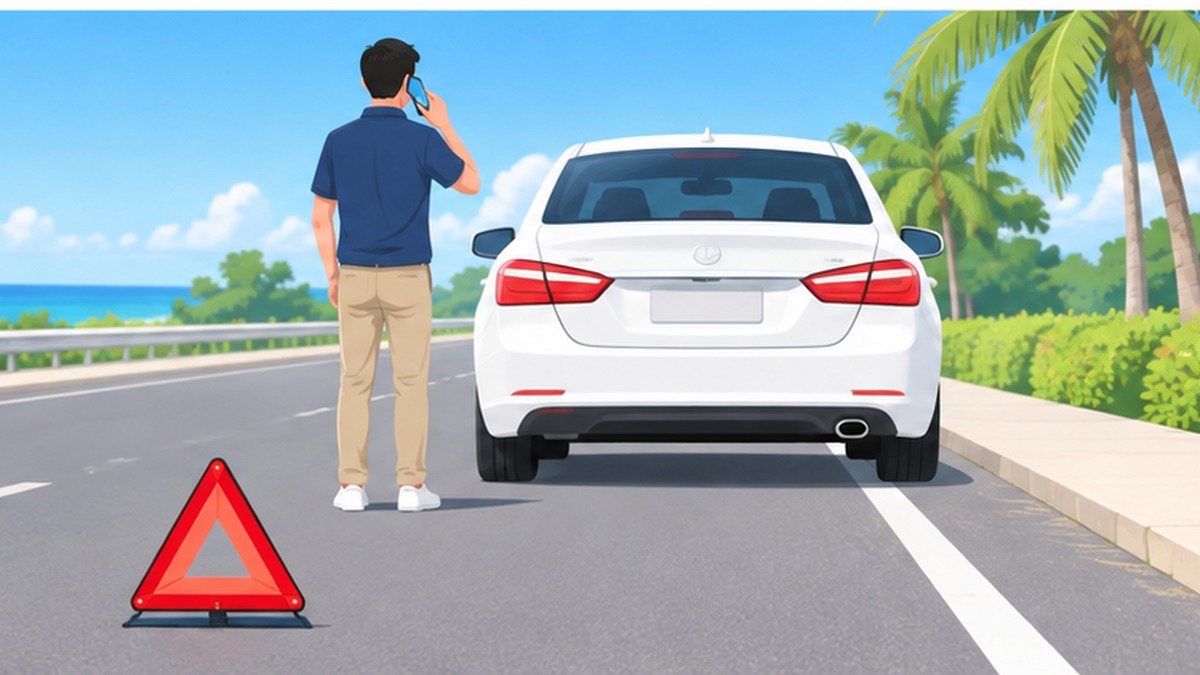
After a crash in Guam, stay where you are, report it to the police immediately and contact our office. Follow these steps:
- Step 1. Stop, stay, and leave the car where it is. Stop immediately and do not leave the scene. Do not move the car, even if it blocks traffic, so the police can see how the accident happened. Check whether anyone is injured; if there is an immediate safety concern, follow the emergency operator's instructions.
- Step 2. Call 911. Report the accident to the Guam Police Department, even if the damage appears minor. Our rental agreement requires every accident to be reported immediately.
- Step 3. Call our office. After contacting the police, call us at +1-671-642-8000 (open 24 hours). Tell us where you are and what happened. A staff member may come to the scene to assist you.
- Step 4. Take photos and exchange information. Photograph the entire accident scene, all dents and scratches on the vehicles involved, and the other vehicle's license plate. Under Guam law, drivers involved in an accident must exchange their full names and addresses, provide their vehicle registration numbers and show their driver's licenses.
- Step 5. Wait for the police and obtain the case number. Remain on site until the officers are done. They will give you a police case number, normally handed over on a small slip; keep it safe. You must provide this number to our office for us to process the accident and apply your coverage.
- Step 6. If your car cannot be driven, ask the towing company to deliver it to our main office in Tumon. You must pay the towing company directly, as towing fees are not covered.
- Step 7. Complete an accident report. After the police have finished, bring your case number to our office and complete a written accident report.
Hit a parked car, wall or pole? Stop immediately and take photos of the damage. Contact our office and report the incident to the police. If you hit an unattended parked car and cannot find its owner, Guam law requires you to leave a written note in a visible place on the vehicle. The note must include your name and address, the vehicle owner's name and address, and a brief description of what happened. You must also send a similar notice to the Guam Police Department within 24 hours, regardless of how minor the damage is.
After the accident: your car and your monthly contract
After an accident, you must settle the outstanding accident-related charges before the damaged car's rental contract can be closed or a replacement car can be provided.
- Paying the charges comes first. The rental contract for the damaged car remains open until all accident-related charges have been paid in full. Once payment is complete, the office can close that contract.
- A replacement car can be provided once all outstanding accident-related charges have been paid in full. If you rely on credit card coverage, check with your card provider whether you must pay the rental company first and then request reimbursement from your card's insurer.
- Your renewal date still matters. If you receive a replacement car, confirm the new contract's expiration date and time with the office. Make sure to renew before that deadline, just as you would with your original rental. See our guide to extending a long-term rental for details.
Small scratches and damage found at return
Any new scratch or dent discovered when you return the car may result in a damage charge, even if it is minor. The same accident service fee also applies. To avoid misunderstandings during a long-term rental, follow these two habits:
- When you pick up the car, walk around it with a staff member and take photos of all sides. Keep the photos until the end of your rental.
- If you scrape or damage something while driving, report it immediately. Call 911 and our office rather than waiting until you return the car. Damage that was never reported to the police on the spot may not be covered.
For the full list of coverage options and fees, see our insurance and coverage page. For details about what your monthly rental includes, see what's included in a monthly rental.
Frequently asked questions
- Is the rental car itself covered by the included insurance?
- No. The liability insurance included in every rental covers injuries and property damage you cause to other people. It does not cover damage to your rental car. For covered car-to-car collisions, you need CDW. Adding ZDW removes the CDW deductible.
- Can I add CDW partway through a long rental?
- Yes. You can add or remove CDW, ZDW and NOC when you renew each month, after the office has inspected the car again.
- Can I use my credit card's rental car coverage?
- Yes, if your card provider confirms that your coverage applies to your rental period. Check the terms for monthly rentals before booking. If an accident happens, you will need to file and manage the claim with your card provider's insurer yourself.
- Will I get a replacement car after an accident?
- A replacement car can be provided once all outstanding accident-related charges have been paid in full. Contact our office to arrange it.
- Do I need to call the police for a small scrape?
- Yes. Our rental agreement requires you to report every accident to the Guam Police Department by calling 911 and to contact our office immediately, even if the damage appears minor. You must obtain a police case number. Without it, the applicable insurance and waivers will not apply.